
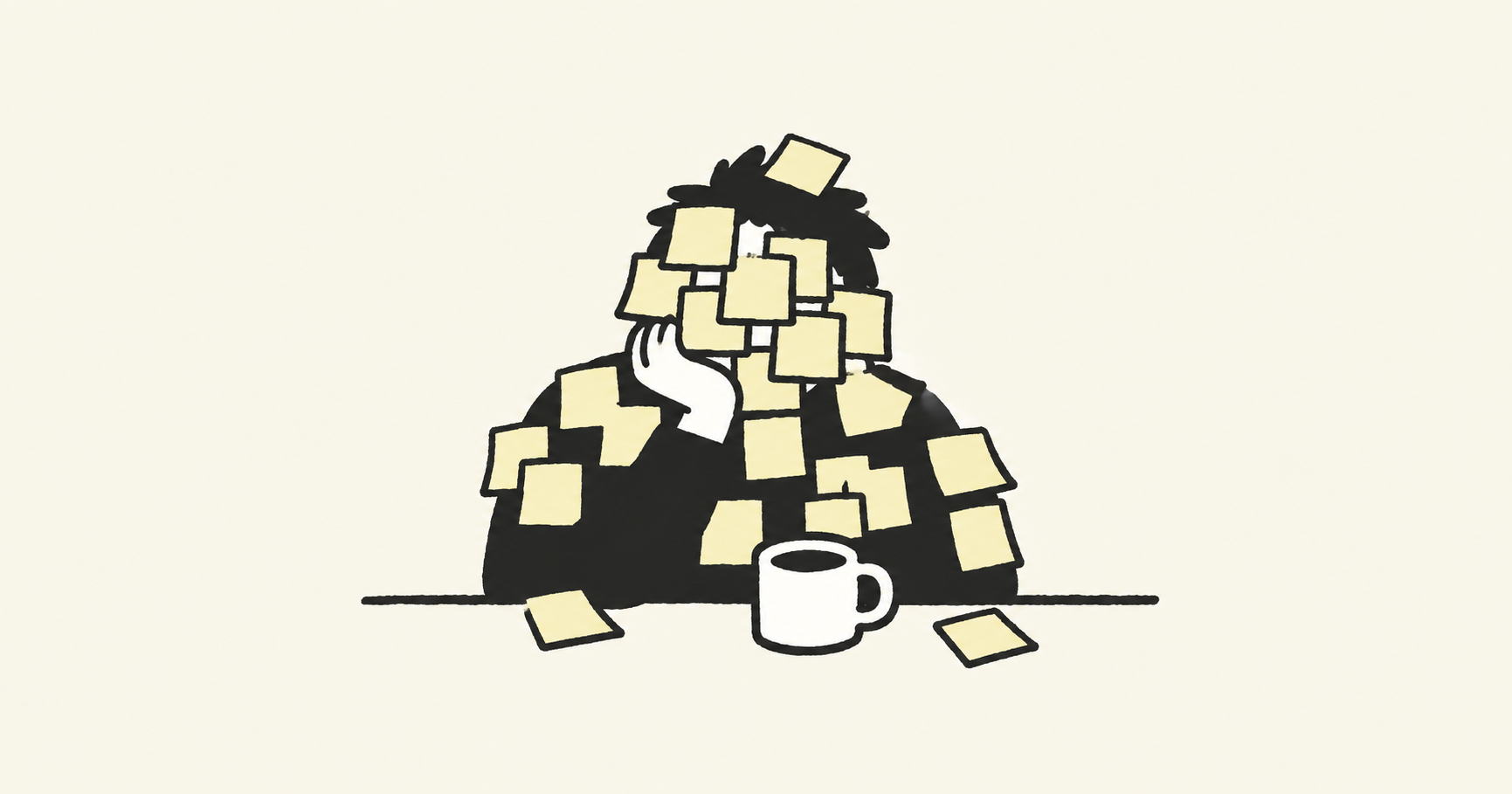
What researchers mean by decision fatigue
The phrase sounds simple, but researchers have not always used it in the same way. A conceptual analysis by Pignatiello and colleagues found that the literature lacked a single clear definition and often mixed decision-making demands with broader self-control, situational and fatigue factors.
A useful working description is this: as demanding decisions accumulate, a person may become more likely to choose an option that requires less mental effort—or to avoid deciding at all.
That description does not assume that the brain contains a literal “decision battery.” It describes a pattern that researchers can test.
Why it feels so familiar
Think about a day that starts with choosing priorities, answering messages, comparing prices, changing plans, deciding what deserves attention and responding to other people's requests. By evening, a tiny question—what to eat, which email to answer first, whether to buy the blue one or the black one—can feel strangely expensive.
That experience is real. What is less obvious is what caused it. Was it the number of decisions? The difficulty of the decisions? Uncertainty? Stress? Time pressure? Hunger? Poor sleep? Constant task-switching?
Feeling tired of choosing does not automatically reveal the mechanism underneath it.
Where the popular idea came from
One influential line of research linked decision-making to the broader idea of ego depletion: the proposal that acts of self-control draw on a limited resource, so exerting control now makes later control harder.
In a 2008 series of experiments, Vohs and colleagues reported that participants who made choices later showed poorer persistence or self-control on other tasks than people in comparison conditions. The findings helped popularise the idea that choosing itself can carry a later cost.
But those experiments supported a behavioural effect under specific laboratory conditions. They did not prove that the brain literally uses up a single fuel every time you decide.
Why the simple “mental battery” story became controversial
The broader ego-depletion literature later ran into replication and measurement problems. In a large preregistered project across 23 laboratories and 2,141 participants, Hagger and colleagues found a very small effect whose confidence interval included zero.
Later meta-analyses and reviews did not all reach the same conclusion. Some analyses argued that a small effect may remain under different statistical assumptions, while others emphasised publication bias, task differences and uncertainty about the mechanism.
So the safest conclusion is not “mental effort never carries over.” It is that the classic one-resource depletion model should not be treated as settled fact.
A tired decision-maker may be real; a universal battery that simply runs down is much less certain.
Decision fatigue, choice overload and ordinary tiredness are not the same
DECISION FATIGUE
CHOICE OVERLOAD
ORDINARY MENTAL OR PHYSICAL FATIGUE
What newer research says
Recent real-world reviews give a more complicated picture than the popular slogan.
A 2025 systematic review of decision fatigue in healthcare examined 82 studies. Across 130 quantitative tests of the hypothesis, 45% found statistically significant support, 32% did not support it and 23% were inconclusive. The authors also noted that decision fatigue was defined and measured inconsistently; many studies used time of day, time into a shift or decision order as a proxy rather than directly measuring a fatigue state.
A separate hospital-focused scoping review also found inconsistent results and highlighted the role of clinician, patient and work-environment factors.
Healthcare is a specific setting, so these numbers should not be treated as an estimate for everyday life. But they illustrate the central problem: later decisions can change, while the reason for that change is often difficult to isolate.
So, is decision fatigue real?
As a context-sensitive pattern, it is plausible and supported in some settings. Repeated demanding decisions may contribute to later shifts toward easier, habitual, default or deferred choices.
As a universal law, the evidence is not strong enough. We cannot say that everyone has the same daily quota of decisions, that each choice consumes a fixed amount of willpower, or that decisions made late in the day are automatically worse.
The useful version of the idea is therefore modest: cumulative decision demand can be one factor that changes how we choose.
Treat decision fatigue as a risk to manage, not a clock or a battery meter.
What actually makes decisions harder?
The research suggests looking beyond the raw number of choices. Decisions tend to become more demanding when several of these are present:
This is one reason “just make fewer decisions” is too simple. A single ambiguous, high-stakes decision can be more demanding than ten familiar low-stakes ones.
MY HEART ROOM — REDUCE THE DECISION LOAD
- DEFAULT: Give recurring low-stakes choices a normal answer.
- BATCH: Group similar decisions so you do not keep rebuilding context.
- NARROW: Use one or two criteria to remove options that do not fit.
- PAUSE: Before a high-stakes choice, check whether you have enough time, information and energy.
- DECIDE: Choose using the criterion you set—not simply the option that feels easiest in the moment.
What to do when every choice feels harder
1. Define the actual decision. “What should I do?” is too wide. Try “Which of these two tasks needs to happen before 4 p.m.?”
2. Use criteria before options. Decide what matters—cost, time, safety, reversibility, quality—before comparing every possibility.
3. Narrow the menu. Remove options that fail your criteria. Two or three viable choices are easier to compare than twelve vaguely acceptable ones.
4. Separate reversible from hard-to-reverse choices. A low-cost decision you can change later usually does not deserve the same analysis as a major commitment.
5. Use defaults for repeated low-stakes choices. A default is not a prison. It is simply the answer you use unless there is a reason to reconsider.
6. Pause before important decisions when you are depleted. If the decision can safely wait, a break, food, sleep or a change of context may be more useful than forcing another round of comparison.
7. Do not worship the clock. There is no universal rule that important decisions must happen in the morning. Aim for a time when you have enough information, attention and emotional space.
Important nuance
Sometimes indecision is appropriate. If information is missing, the stakes are high or the choice is difficult to reverse, slowing down may be sensible rather than a failure of self-control.
Persistent difficulty making everyday decisions can also occur alongside chronic stress, anxiety, low mood, ADHD-related executive-function difficulties, burnout, poor sleep, pain or other pressures. The label “decision fatigue” cannot identify the cause by itself. If decision problems are repeatedly disrupting work, study, relationships or daily functioning, a qualified professional can help you explore what is contributing.
Learn the psychology
Decision fatigue · Decision making · Cognitive load · Choice overload
Self-control · Mental fatigue · Executive function · Uncertainty
References
- Pignatiello, G. A., Martin, R. J., & Hickman, R. L., Jr. (2020). Decision fatigue: A conceptual analysis. Journal of Health Psychology, 25(1), 123–135. ↗ Journal of Health Psychology.
- Vohs, K. D., Baumeister, R. F., Schmeichel, B. J., Twenge, J. M., Nelson, N. M., & Tice, D. M. (2008). Making choices impairs subsequent self-control: A limited-resource account of decision making, self-regulation, and active initiative. Journal of Personality and Social Psychology, 94(5), 883–898. ↗ Journal of Personality and Social Psychology.
- Hagger, M. S., Chatzisarantis, N. L. D., Alberts, H., et al. (2016). A Multilab Preregistered Replication of the Ego-Depletion Effect. Perspectives on Psychological Science, 11(4), 546–573. ↗ Perspectives on Psychological Science.
- Dang, J. (2018). An updated meta-analysis of the ego depletion effect. Psychological Research, 82, 645–651. ↗ Psychological Research.
- Friese, M., Loschelder, D. D., Gieseler, K., Frankenbach, J., & Inzlicht, M. (2019). Is Ego Depletion Real? An Analysis of Arguments. Personality and Social Psychology Review, 23(2), 107–131. ↗ Personality and Social Psychology Review.
- Chernev, A., Böckenholt, U., & Goodman, J. (2015). Choice overload: A conceptual review and meta-analysis. Journal of Consumer Psychology, 25(2), 333–358. ↗ Journal of Consumer Psychology.
- Maier, M., Powell, D., Murchie, P., & Allan, J. L. (2025). Systematic review of the effects of decision fatigue in healthcare professionals on medical decision-making. Health Psychology Review, 19(4), 717–762. ↗ Health Psychology Review.
- Perry, K., Jones, S., Stumpff, J. C., et al. (2025). Decision fatigue in hospital settings: A scoping review. Journal of Hospital Medicine, 20(4), 385–395. ↗ Journal of Hospital Medicine.
- Linder, J. A., Doctor, J. N., Friedberg, M. W., et al. (2014). Time of Day and the Decision to Prescribe Antibiotics. JAMA Internal Medicine, 174(12), 2029–2031. ↗ JAMA Internal Medicine.